The United States has been unhappy with Canada’s dairy Tariff-Rate-Quota (TRQ) administration. Notably, low utilization rates for several TRQs appear to be a source of frustration for the United States. In a previous post, I explain the Canada-United States-Mexico Agreement (CUSMA) dairy disputes between Canada and the United States and discuss related topics.
One question at the core of the dispute is whether Canada’s dairy TRQ administration prevents their full utilization. That is, does Canada administer its TRQ in a way that introduces non-tariff barriers (NTB)? In this second post, I follow up with an analysis of arguments that the Canadian government administers dairy import rights in a way that prevents the full use of market access granted in CUSMA. I will debunk the following two arguments:
- Granting import licences to retailers would increase Canadian imports of US dairy products;
- Canadian firms do not have incentives to import US dairy products that compete with their own products.
If these arguments hold, it would mean that modifications to the administration of Canada’s dairy TRQs would result in higher utilization rates.
There are legitimate explanations for low TRQ utilization rates. In my previous post, I explain that if the import demand is low relative to the world price, then the import volume is low and the TRQ will not be filled. Consumer preferences also matter. If consumers strongly prefer domestic products, then they will require a significant discount to purchase imported products. That means US dairy products will not flood the Canadian dairy market even though their prices are lower in the US than the same products in Canada.
Allocation of import licences to retailers
The United States contends that excluding retailers from eligibility for dairy import licences causes lower fill rates. I have seen this argument take different forms. One is that processors will import products that must undergo additional processing before sale to consumers (Turland, Barichello and Carter, 2023). Retailers, by contrast, would import consumer-ready products with higher commercial value. That argument, obviously, does not work for several TRQs for dairy ingredients, e.g., powders, concentrated and condensed milk, products consisting of natural milk constituents, and industrial cheeses.
A second argument is that retailers are more likely to import products that consumers want. It is true that retailers may be better informed of consumer preferences because they have a closer relationship with them. However, that information is easily communicable to businesses upstream in the supply chain. Processors and further processors are also well aware of what consumers want as they are involved in the production of the goods sold at retail. As we will see below, information flows in a supply chain and consumer demand at retail affects the demand at all stages of the supply chain. In any case, if a retailer wants a US product on its shelves, it can contact an eligible business that can import the product on its behalf. Nothing prevents a retailer from contracting with an eligible business to import dairy products.
A third argument is that the demands by processors and retailers are different and therefore not giving import rights to retailers effectively constrains the total import demand. This is what Schaefer and Wolf (2025) show in their conceptual model. This conclusion rests on an assumption that processor and retailer demands can be treated as independent sources of import demand. As shown below, an economic model of a supply-chain shows that these demands are interconnected and that they cannot be summed to obtain a total demand.
I show graphically how supply chains operate. I demonstrate the connection between the different stages of a supply chain and how imports at one stage affect the supply or the demand at other stages of the supply chain. For simplification, I assume there are only processors and retailers. Processors transform raw products into consumer products, sell those products to retailers who sell them to consumers. I’ll assume a one-to-one relationship between volumes at processing and retail. What I will demonstrate with this simplified supply chain applies as well to a more complicated supply chain.
Imports by processors
I consider first the case where only processors can import. The assumption is that the world price is low and that the TRQ is filled.
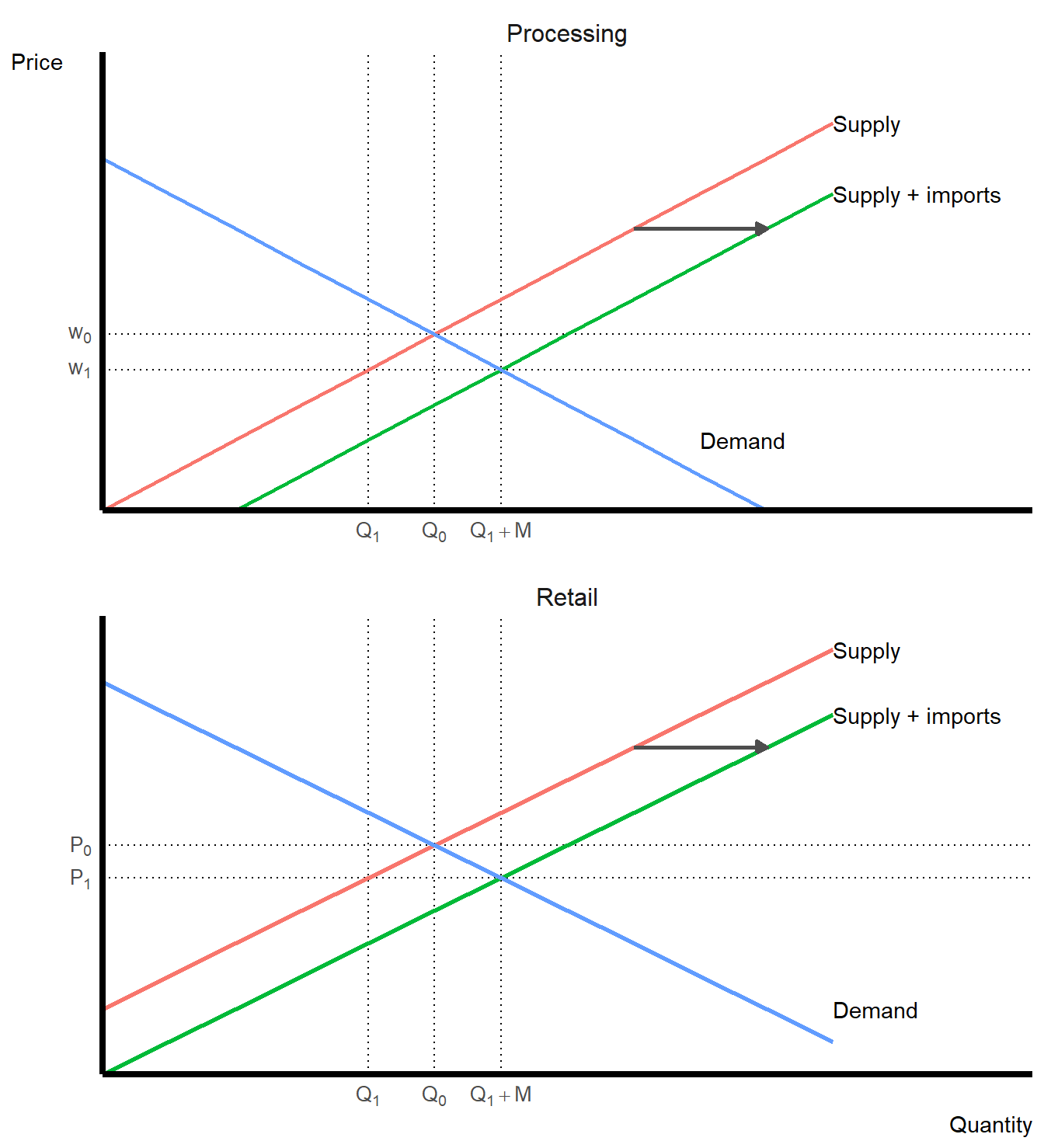
Figure 1 shows supply and demand lines for a supply chain with processors and retailers. The processing stage is at the top and the retail stage at the bottom. In each facet of the figure, the supply lines slope up and the demand lines slope down. At the processing stage, the supply by the processors is for consumer-ready products. The demand is from the retailers for consumer-ready products. At retail, the demand is from consumers. The supply is from the retailers who sell to consumers the products purchased from the processors. The supply at retail derives from the supply at processing. That is, whatever happens to the supply at processing will directly affect the supply at retail. Likewise, the demand at processing derives from the demand at retail. Whatever happens at retail impacts the demand at the processing stage.
Let’s consider first the base case where there are no imports. At the processing stage, the demand and the supply intersect at a quantity \(Q_0\) and a price \(w_0\). I assume a one-to-one relationship between processing and retail such that the supply and the demand at retail also intersect at \(Q_0\). The price at retail is \(P_0 > w_0\), where the retail demand and supply intersect.
Second, let’s consider the case where processors import a quantity \(M\). The effect of imports is to shift the supply at processing to the right. Processors can import either consumer-ready products or ingredients. By importing ingredients, processors lower their production cost, which shifts the supply to the right. Importing consumer-ready products also shifts the supply to the right. In either case, the result is that the total supply, the sum of domestic production and imports, intersects the demand at a price \(w_1 < w_0\). The domestic production is \(Q_1 < Q_0\) where the supply without imports equals the price \(w_1\). The total quantity is the domestic production plus imports: \(Q_1 + M\). The impact of imports is as expected: a lower domestic price, a lower domestic production but a greater total quantity.
What happens at processing also affects retail. The supply at retail also shifts by the import volume. If it was not the case, then quantities at processing and retail would not match. The price is found at the intersection of the total supply and the demand is \(P_1 < P_0\) and the total quantity is \(Q_1 + M\). That is, what happens upstream flows downstream, affecting the market outcome at retail.
Imports by retailers
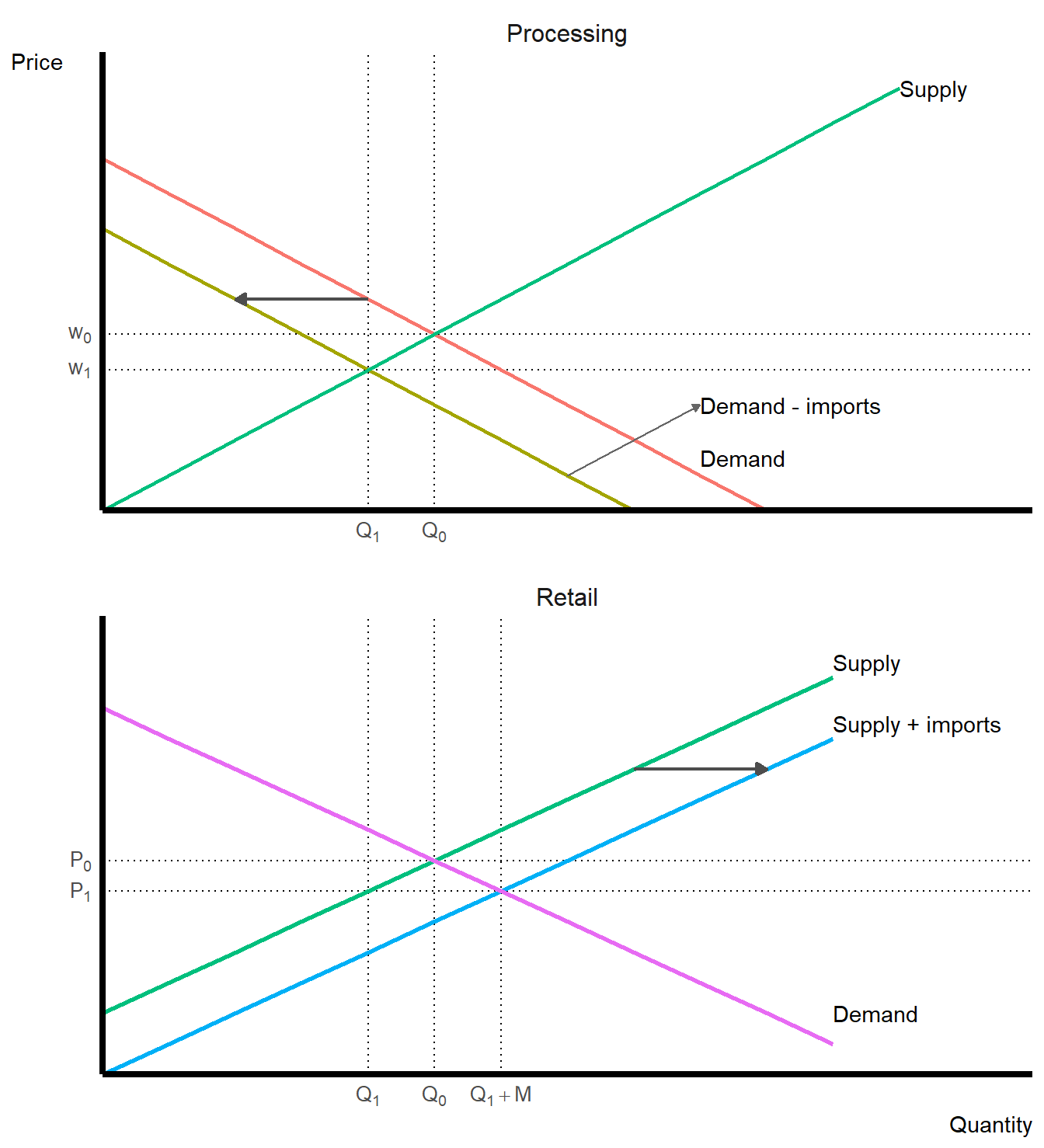
Figure 2 shows a supply chain where it is the retailers that have the right to import a quantity \(M\). Everything else is the same as in Figure 1. Again, in the case without imports the equilibrium quantity is \(Q_0\), the price at processing is \(w_0\) and the price at retail is \(P_0\).
Retailers import a quantity \(M\) shifting the supply at retail by that quantity. The price declines to \(P_1\) and the total quantity is \(Q_1 + M\). These are the same values as in Figure 1. Observe at retail that at a price \(P_1\) the domestic quantity on the supply without imports is \(Q_1\). This means that because of imports, the retail stage demands a smaller quantity from processors. At processing, this causes the demand to shift to the left by the quantity \(M\), and the demand minus imports meets the supply at a quantity \(Q_1\) and a price \(w_1\).
Takeaways
Figure 1 and Figure 2 show that it does not matter who imports. The market outcome is the same whether it is processors or retailers who have the import rights. In a well-working supply chain, what happens at one stage affects what happens at other stages. The implication is that if it is profitable to import for retailers, it will also be profitable to import for processors. Even if retailers do not have import rights, they can easily communicate their needs to businesses that have import rights.
Who obtains the import rights matters because the businesses that have those rights can capture a rent, i.e., profit, from importing. As I mentioned in my previous post, the Canadian government chose to give import rights to processors, further processors and distributors to compensate them for handling smaller volumes.
The figures above show that the argument regarding giving import allocations to retailers does not hold. Anyway, that argument would have worked only for a few TRQs that include products that can be sold at retail without further processing like Butter and Cream Powders, Cheeses of All Types and perhaps also Cream and Yogurt and Buttermilk. Moreover, the TRQs for Butter and Cream Powders and Cheeses of All Types are already virtually filled.
Do domestic firms want to import?
The second argument I will examine is whether domestic firms want to import products that effectively compete with their own output. We will see that the problem is akin to the prisoner’s dilemma game.
To understand the problem, let me consider an example with two firms who produce domestically and who are eligible to obtain import allocations. Considering two firms is sufficient to understand firms’ import decisions. We will label them Firm R (for row) and Firm C (for column). The numerical values are illustrative and were not selected to obtain a specific result. The values are coherent with the outcomes one could obtain from an economic model, and what matters are the relative values of the payoffs.
We assume that when no firm imports, they earn in total $150 with Firm R earning $100 and Firm C earning $50. If one or the two firms import, competition from imports causes a lower domestic price, domestic production declines and firms in total earn domestically $120: Firm R earns $80 and Firm C earns $40. When imports occur, the total payoff from importing to firm(s) who import is $24. The drop in the domestic payoff ($30=$150-$120) is larger than the import payoff ($24) because prices decline in the domestic market. The payoffs for importing depend on the choice firms make:
- Firm R imports but Firm C does not import: Firm R earns $24 and Firm C earns $0;
- Firm C imports but Firm R does not import: Firm C earns $24 and Firm R earns $0.
- Firm C and Firm R import: Imports are allocated based on market share such that Firm R earns $16 from imports and Firm C earns $8 from imports.
Table 1 shows the payoffs for the two firms in matrix form. We refer to the possible actions of the two firms as strategies. The strategies of Firm R, either Import or No import are in the rows. The same strategies for Firm C are in the columns. In the boxes, the payoffs on the left of “|” are for Firm R and the payoffs on the right of “|” are for Firm C.
| Firm C: Imports | Firm C: No imports | |
|---|---|---|
| Firm R: Imports | $96 = $80 + $16 | $48 = $40 + $8 | $104 = $80 + $24 | 40 |
| Firm R: No imports | $80 | $64 = $40 + $24 | $100 | $50 |
Consider first the strategies of Firm R. If Firm C imports, Firm R earns $80 with the No import strategy but earns $96 with the Import strategy. If Firm C does not import, Firm R earns $100 with the No import strategy but earns $104 with the Import strategy. That is, whatever Firm C’s strategy, Firm R is better off when it imports. Import is a dominant strategy for Firm R. Import is also a dominant strategy for Firm C as regardless of the strategy selected by Firm R, it does better when it selects the Import strategy. Given that Import is the dominant strategy for both firms, the solution where both firms import is the solution of the game, technically referred to as the Nash equilibrium.
Observe in the example that the firms are worse off when they both import compared to the status quo where they do not import: $96<$100 for Firm R and $48<$50 for Firm C. Nonetheless, the firms both select the Import strategy. This is because they cannot coordinate and ensure that the other firm will not import. They cannot trust that the other firm will not cheat and import. That is, the firms must behave considering only their own interests and it is best for them to select the Import strategy. This is the same outcome as in the Prisoner’s dilemma game. The example could be extended to several firms without changing the outcome that the dominant strategy for all firms is Import. Actually, with several firms, enforcement is more difficult and therefore the impetus to import is even stronger.
The game in Table 1 is static, meaning the firms play the game once. In practice, the import game is repeated every year. The literature does show that collusion, the No Import strategy here for the two businesses, can be sustained in repeated games under conditions that include “craziness” or unpredictability of the firms, the discount rate, the number of times the game repeats and the threat of punishment. That is a theoretical possibility that I doubt is occurring in reality because of Canada’s Competition Act.
The takeaway is that businesses will import even if the products imported compete with their own. If importing is profitable, and a business does not take the opportunity to import, then another business will. Thus, Canadian businesses have every incentive to import from the United States when it is profitable to do so.
Conclusion
My overall take on Canada’s dairy import system is that it is working well. Chiefly, utilization rates for Canadian dairy TRQs reflect import profitability. Canadian businesses have been importing butter and cheese, nearly filling these TRQs every year. There is a strong demand for these products in Canada. By contrast, protein products have been relatively more abundant in Canada until recently, and accordingly Canadian firms have not filled the TRQs for dairy powders high in that component.
Turland, Barichello and Carter (2023) characterize the first CUSMA dairy dispute as a tempest in a teapot involving small economic potatoes. The authors write that the dispute is mainly the results of politics, and the economic benefits are relatively small. I think they are right. Today, access to the Canadian dairy market is an issue President Trump uses to rally his base. The CUSMA agreement has been working well, but it serves as a good punching bag for President Trump.
I think there are good arguments in support of Canada’s dairy TRQ system 1) giving the right incentives to businesses to import, and 2) not putting administrative mechanisms to prevent their use. However, these arguments may have limited importance. My point of view is that US tariff policies do not appear driven primarily on economic arguments but rather on President Trump’s system of beliefs and gut feelings, and the desire to extract a rent from US trade partners. I do not really see a point for Canada to argue with rational arguments: (conventional) rationality is not driving US trade policies and therefore rational arguments will not prevail. In the show 30 Rock, Jack explains to Liz that someone irrational does not respond to rationality, but responds to fear. It’s unfortunate that Canada does not really have a way to pressure the US without significantly harming itself. In the circumstances, the best strategy for Canada may be to do nothing.